A Philosophical Approach to UX Design
Discover how leaning into ambiguity and philosophical thinking can lead to more human-centered, resilient UX design. This article explores how embracing uncertainty helps designers create with empathy, adaptability, and deeper insight.
Insights
Aug 4, 2024
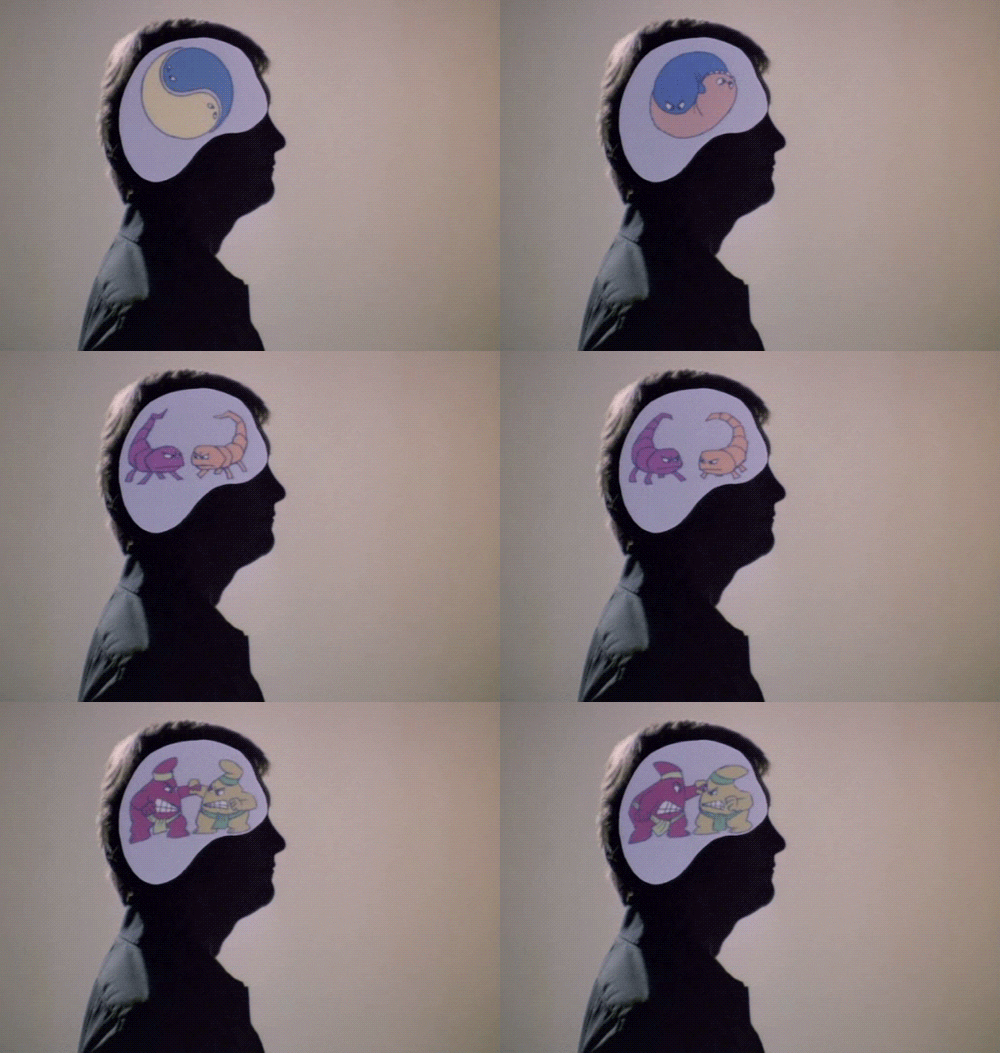
Life is inherently unpredictable. If we were to know the exact moment of our death, the nature of our worries would change entirely. Rather than being consumed by the daily challenges we face, we might focus on savoring the fleeting moments we have left. This duality of unpredictability both daunting and soothing mirrors the intricacies of user experience (UX) design.

The Paradox of Uncertainty
Uncertainty in life can be unsettling. It forces us to confront the unknown and often compels us to prepare for the worst. However, it’s this very unpredictability that can also be profoundly liberating. Without a fixed endpoint, life retains its richness, allowing us to experience joy, curiosity, and wonder.
Similarly, in UX design, uncertainty can be both a challenge and an opportunity. As designers, we are tasked with creating experiences that guide users through the unknown. Users often approach a product or service with a degree of uncertainty like "How will this work? Will it meet my needs? How do I navigate this interface?" These questions are natural, and it’s our responsibility as UX designers to address them.

Designing for Uncertainty
In UX, we don’t eliminate uncertainty; instead, we manage it. A well-designed interface anticipates the user’s needs and provides clear, intuitive guidance. This doesn’t mean that everything needs to be predictable or overly simplistic. On the contrary, a degree of uncertainty can engage users, prompting exploration and discovery. It’s about striking a balance providing enough structure to make the experience comfortable while leaving room for the unexpected.
For instance, consider the onboarding process of a new app. A user might initially feel unsure about how to get started. A thoughtful design will gently guide them through the initial steps, offering reassurance while encouraging exploration. By gradually revealing features and providing contextual hints, we help users build confidence in their ability to navigate the unknown.
Uncertainty as a Design Principle
Philosophically, embracing uncertainty allows us to appreciate life’s unpredictability, finding peace in the unknown. In UX design, a similar approach can enhance the user experience. By acknowledging the inherent uncertainty in human-computer interaction, we can create designs that are not only functional but also emotionally resonant.
Designers should consider unpredictability as a tool. Not something to be feared, but something to be harnessed. By embracing uncertainty, we can create experiences that are more engaging, more human, and ultimately, more satisfying.
Conclusion
Life’s unpredictability is a source of both anxiety and liberation. In UX design, the same principle applies. By understanding and embracing uncertainty, we can create experiences that are not only user-friendly but also deeply meaningful. Just as we might find comfort in the unpredictability of life, users can find joy in the exploration and discovery that comes with a well-designed product.
Embracing uncertainty in UX design isn’t just about solving problems, it is about creating experiences that resonate with the unpredictable nature of life itself.
More to Discover


A Philosophical Approach to UX Design
Discover how leaning into ambiguity and philosophical thinking can lead to more human-centered, resilient UX design. This article explores how embracing uncertainty helps designers create with empathy, adaptability, and deeper insight.
Insights
Aug 4, 2024
Life is inherently unpredictable. If we were to know the exact moment of our death, the nature of our worries would change entirely. Rather than being consumed by the daily challenges we face, we might focus on savoring the fleeting moments we have left. This duality of unpredictability both daunting and soothing mirrors the intricacies of user experience (UX) design.
The Paradox of Uncertainty
Uncertainty in life can be unsettling. It forces us to confront the unknown and often compels us to prepare for the worst. However, it’s this very unpredictability that can also be profoundly liberating. Without a fixed endpoint, life retains its richness, allowing us to experience joy, curiosity, and wonder.
Similarly, in UX design, uncertainty can be both a challenge and an opportunity. As designers, we are tasked with creating experiences that guide users through the unknown. Users often approach a product or service with a degree of uncertainty like "How will this work? Will it meet my needs? How do I navigate this interface?" These questions are natural, and it’s our responsibility as UX designers to address them.
Designing for Uncertainty
In UX, we don’t eliminate uncertainty; instead, we manage it. A well-designed interface anticipates the user’s needs and provides clear, intuitive guidance. This doesn’t mean that everything needs to be predictable or overly simplistic. On the contrary, a degree of uncertainty can engage users, prompting exploration and discovery. It’s about striking a balance providing enough structure to make the experience comfortable while leaving room for the unexpected.
For instance, consider the onboarding process of a new app. A user might initially feel unsure about how to get started. A thoughtful design will gently guide them through the initial steps, offering reassurance while encouraging exploration. By gradually revealing features and providing contextual hints, we help users build confidence in their ability to navigate the unknown.
Uncertainty as a Design Principle
Philosophically, embracing uncertainty allows us to appreciate life’s unpredictability, finding peace in the unknown. In UX design, a similar approach can enhance the user experience. By acknowledging the inherent uncertainty in human-computer interaction, we can create designs that are not only functional but also emotionally resonant.
Designers should consider unpredictability as a tool. Not something to be feared, but something to be harnessed. By embracing uncertainty, we can create experiences that are more engaging, more human, and ultimately, more satisfying.
Conclusion
Life’s unpredictability is a source of both anxiety and liberation. In UX design, the same principle applies. By understanding and embracing uncertainty, we can create experiences that are not only user-friendly but also deeply meaningful. Just as we might find comfort in the unpredictability of life, users can find joy in the exploration and discovery that comes with a well-designed product.
Embracing uncertainty in UX design isn’t just about solving problems, it is about creating experiences that resonate with the unpredictable nature of life itself.
More to Discover
A Philosophical Approach to UX Design
Discover how leaning into ambiguity and philosophical thinking can lead to more human-centered, resilient UX design. This article explores how embracing uncertainty helps designers create with empathy, adaptability, and deeper insight.
Insights
Aug 4, 2024
Life is inherently unpredictable. If we were to know the exact moment of our death, the nature of our worries would change entirely. Rather than being consumed by the daily challenges we face, we might focus on savoring the fleeting moments we have left. This duality of unpredictability both daunting and soothing mirrors the intricacies of user experience (UX) design.
The Paradox of Uncertainty
Uncertainty in life can be unsettling. It forces us to confront the unknown and often compels us to prepare for the worst. However, it’s this very unpredictability that can also be profoundly liberating. Without a fixed endpoint, life retains its richness, allowing us to experience joy, curiosity, and wonder.
Similarly, in UX design, uncertainty can be both a challenge and an opportunity. As designers, we are tasked with creating experiences that guide users through the unknown. Users often approach a product or service with a degree of uncertainty like "How will this work? Will it meet my needs? How do I navigate this interface?" These questions are natural, and it’s our responsibility as UX designers to address them.
Designing for Uncertainty
In UX, we don’t eliminate uncertainty; instead, we manage it. A well-designed interface anticipates the user’s needs and provides clear, intuitive guidance. This doesn’t mean that everything needs to be predictable or overly simplistic. On the contrary, a degree of uncertainty can engage users, prompting exploration and discovery. It’s about striking a balance providing enough structure to make the experience comfortable while leaving room for the unexpected.
For instance, consider the onboarding process of a new app. A user might initially feel unsure about how to get started. A thoughtful design will gently guide them through the initial steps, offering reassurance while encouraging exploration. By gradually revealing features and providing contextual hints, we help users build confidence in their ability to navigate the unknown.
Uncertainty as a Design Principle
Philosophically, embracing uncertainty allows us to appreciate life’s unpredictability, finding peace in the unknown. In UX design, a similar approach can enhance the user experience. By acknowledging the inherent uncertainty in human-computer interaction, we can create designs that are not only functional but also emotionally resonant.
Designers should consider unpredictability as a tool. Not something to be feared, but something to be harnessed. By embracing uncertainty, we can create experiences that are more engaging, more human, and ultimately, more satisfying.
Conclusion
Life’s unpredictability is a source of both anxiety and liberation. In UX design, the same principle applies. By understanding and embracing uncertainty, we can create experiences that are not only user-friendly but also deeply meaningful. Just as we might find comfort in the unpredictability of life, users can find joy in the exploration and discovery that comes with a well-designed product.
Embracing uncertainty in UX design isn’t just about solving problems, it is about creating experiences that resonate with the unpredictable nature of life itself.